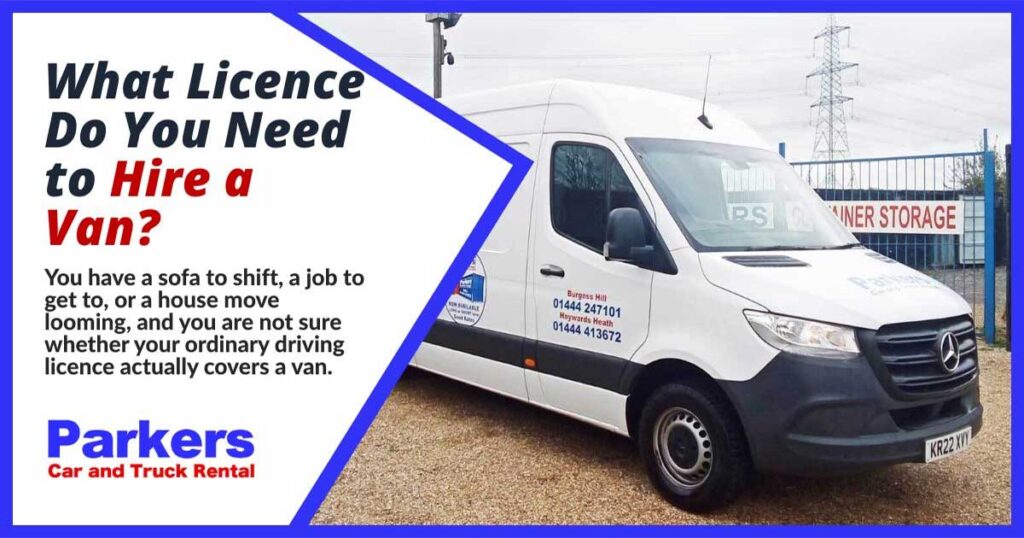
It is the question that stops a lot of people before they even pick up the phone. You have a sofa to shift, a job to get to, or a house move looming, and you are not sure whether your ordinary driving licence actually covers a van.
For hiring from us, the answer is simple. It does.
The short answer
Every van in our fleet sits within the 3,500kg limit that a standard UK car licence covers. That runs from a small car-derived van right through to a long wheelbase Luton with a tail lift. No extra test, no additional entitlement, nothing to apply for.
The weight figure is the important part, not the size of the van. A Luton box van looks enormous parked next to a hatchback, but its maximum authorised mass is inside the limit, so your ordinary licence covers it.
What category B actually means
The entitlement you are relying on is category B. Look at the back of your photocard licence and you will find a table of vehicle categories with dates beside them. Category B is the car one, and it permits vehicles up to 3,500kg maximum authorised mass with up to eight passenger seats.
Maximum authorised mass is the weight of the van plus everything you put in it, not the empty weight. This matters more than people expect. A van loaded to the roof with books, tools or paving slabs gets closer to that limit than the same van carrying bulky but light furniture. If you are unsure what you are carrying, ring us and we will point you at the right vehicle.
What about 7.5 tonne vehicles?
You may have come across the 7.5 tonne question when researching van hire, so it is worth clearing up. Vehicles between 3,500kg and 7,500kg need category C1 on your licence, which is a separate entitlement.
It does not apply to anything we hire. Our whole range is within 3,500kg, so if you are booking with us you can put the C1 question aside entirely. If you genuinely need something heavier, you would be looking at a specialist commercial hire firm rather than us.
How to check what is on your licence
Turn your photocard over. The table on the back lists every category you hold, with valid-from and valid-to dates for each. Category B is the one that matters here.
You can also check online through the DVLA licence checking service, which shows your categories, any penalty points, and lets you generate a check code. Generate that code before you set off, because we will ask for it.
What Parkers needs to see
Our own requirements sit alongside the DVLA rules rather than replacing them. For van hire:
- You must have held a full UK licence for at least two years. Non-UK licences are accepted with proof of two years’ driving experience.
- Drivers must be aged 21 to 75 for standard vehicles, 25 to 75 for 7-seater and 3.5 ton vehicles, and over 30 for Group CS1 vehicles.
- No more than 6 penalty points if you have held your licence for less than five years.
- No driving bans within the last 10 years.
- No more than one accident in the last three years.
On the day, you will need your photocard licence, your DVLA check code, and two proofs of address such as a bank statement and a utility bill. Payment is by credit or debit card, and the cardholder needs to be present.
Towing a trailer
The rules here changed in December 2021 and plenty of people missed it. Drivers holding category B entitlement can now tow a trailer up to 3,500kg without taking a separate B+E test. The change may not yet show on your photocard, and it will only appear the next time you deal with the DVLA, but the entitlement applies regardless.
If you are planning to tow, let us know when you book so we can make sure the vehicle is suitable and properly equipped.
Where people get caught out
A few recurring ones worth heading off.
Assuming a big van needs a special licence. It does not. Size and weight are different things, and the vans people picture as needing something extra are comfortably within the category B limit.
Turning up without a check code. This is the single most common hold-up at collection. It takes two minutes to generate online and saves a frustrating wait at the counter.
Not having held the licence long enough. The two-year requirement catches out younger drivers in particular. It is worth checking the date on your licence before you book rather than on the day.
Assuming minibuses work the same way. They do not. If your job involves moving people rather than things, the rules are stricter and a standard car licence is not enough. We have covered that in our guide to minibus licence requirements.
Still not sure?
If you have looked at the back of your licence and you are still unsure whether it covers what you need, ring us. We would far rather spend two minutes on the phone working it out than have you arrive at the branch and find there is a problem. Our team deals with this every day and can usually settle it straight away.
Take a look at our full van range to find the right size for the job, or get in touch and we will talk it through.